Subject: Read Aloud (E.L.A.) Grade 2
Aim: How do we define an antonym?
Instructional Objective: Students will be able to define an antonym and show examples of antonym pairs.
Standards: E1d, E3b, E4a, E5b
Materials: Opposites by A. Dena, 2 sets of 30 index cards which contain 15 antonym pairs, 1 timer, dry erase marker and board, Post-its, 15 stick figure graphical organizers and standings board.
Motivation: Who wants to make their writing more interesting and fun to read? Today we will learn about antonyms and how to use them in our work.
Procedure:
1. Define the word antonym and provide an example on the board. Example: Today is hot. The antonym of hot is cold. What happens when we replace a word with its opposite?
2. Introduce the book Opposites by Dena. Show students the cover, and ask them what they see. Make sure students know that another word for antonym is opposites.
3. Read page 6 to the students, and show the picture of tall and short animals to the students to reinforce the opposite pair.
4. Tell students to look at the next page, read the questions to them, and get answers from the students. What animals are tall, short?
5. On page 8, a post-it will cover the pair of opposites and the second sentence. Read just the first sentence and have students predict or guess the opposite for the word in bold in the first sentence. Then have students complete matching on the next page.
6. The teacher will have the students read aloud page 10 and again have student predict the word, and answer the question on the next page.
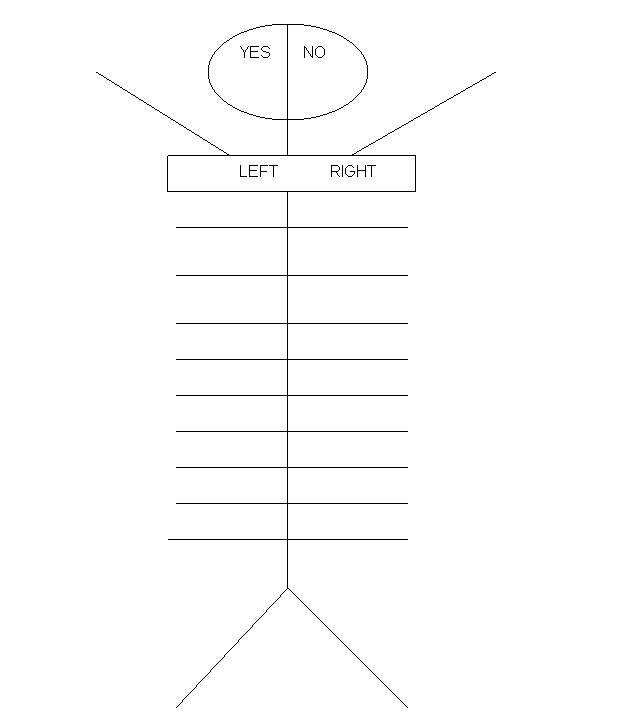
7. Show students the stick figure graphical organizer (encl) and model out one or two pairs of opposites with them.
8. Students then return to their desks and independently complete the graphical organizer with antonym pairs.
9. When students are completed, they will work in small groups of four and compare and discuss their antonym pairs (A cooperative/individual (small group), application activity).
10. When this is done, several students will then share to the whole class.
Conclusion/Share Out: (whole-group) Students will share some of the antonym pairs they created. Students will wrap-up answering the following questions: What are antonyms? What happens to the meaning of a sentence if we switch a word with its opposite?
Assessment: Look at students’ independent work with antonym pairs and collect the homework tomorrow.
Extended Activity: Two students at a time will be working in the literacy center to reinforce their antonym skills. I will give brief instructions and ask them to follow the step-by-step instructions and checklist. There is a pre-determined list of student going to the literacy center. Each student takes an envelope filled with 30 index cards. The timer is set to three minutes. The students’ goal is to match up as many antonym pairs they can in the allotted time. When the time is up, the students will check each other’s work, then count and post the number of correct antonym pairs on the standings board at the center. Students will then reset the center and return to their desks to work on their graphical organizer. The next set of students will move to the center.
Homework: Write a story about yourself using the antonym pairs you made in class. Include a picture or drawing to illustrate your story.
Checklist at Literacy Center
1. Review the definition of antonyms.
2. Take an envelope of index cards.
3. Set up the timer for three minutes.
4. Start the timer and match up as many antonyms pairs as possible in the three minutes.
5. When time is up, Stop!
6. Check your partner’s work and confirm the antonym pairs.
7. Count the number of correct antonym pairs.
8. Post results on standing’s board. (Name and #)
9. Return to your desk and work on the graphical organizer.
Graphical Organizer
Write words that describe you on the left side of the stick figure. Put the antonym for each word on the right side of the figure. Follow the example given.
 Return
to Homepage
Return
to Homepage